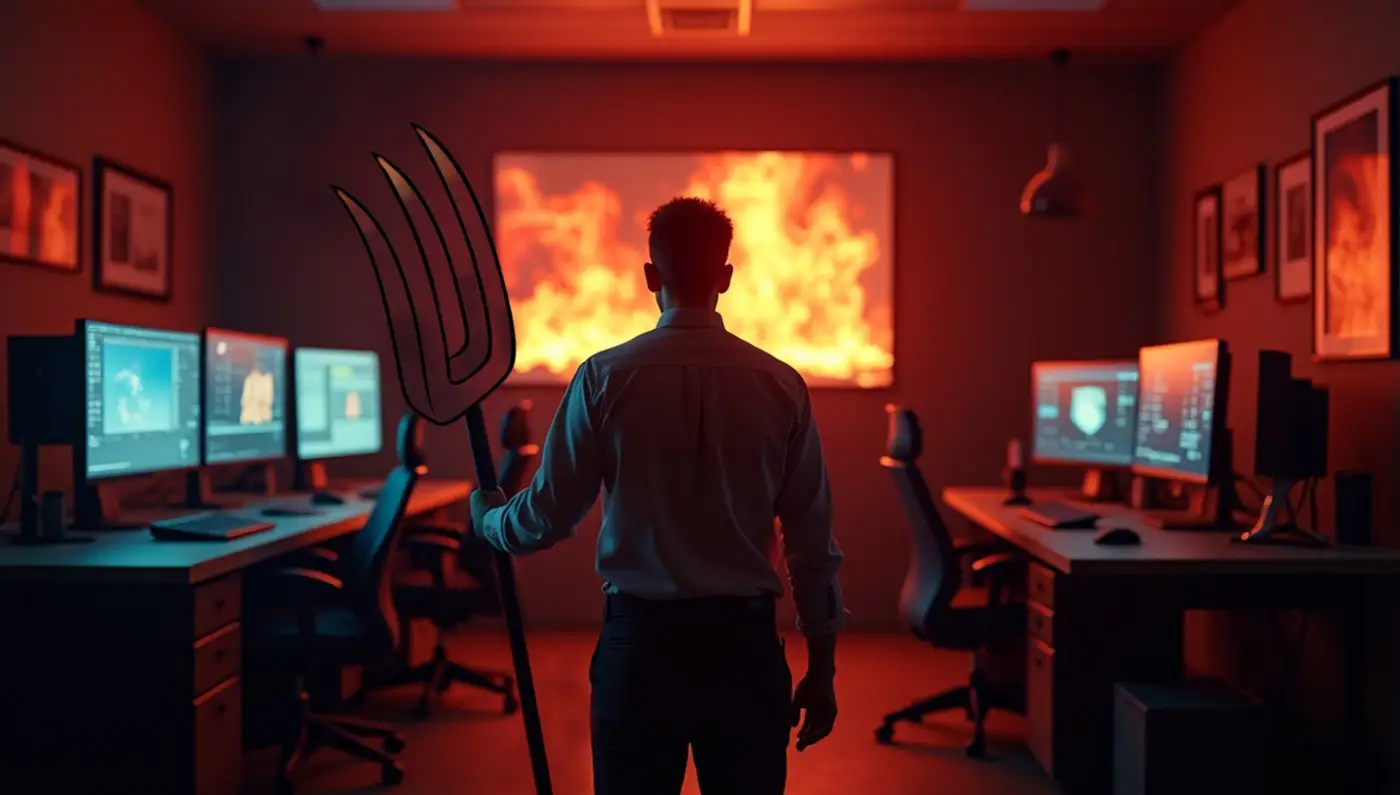
The devil probably doesn't use an impossible pitchfork like the one in the illustration, but when it comes to the customer's soul, he's sure to be hung up on small details in the sales contract. But let's focus on the details. Sometimes it's the little things that make the difference between brilliant and average. In many industries, "details" are not the whims of perfectionists - they are the basis of quality, efficiency and style. But there are areas where you can turn a blind eye and nothing will happen. Let's look at three, at least somewhat related, examples: film editing, programming and... wide format printing.
In film editing, details can literally come down to a single frame. A badly edited scene, a pause that is too long or a cut in the wrong place can disrupt the rhythm of the narrative, spoil the tension or even take the viewer out of the story. Example? A scene with emotional dialogue - if the editor leaves the actor's reaction a second too long, the drama will turn into an embarrassment. Of course, the director always has the last word, but no filmmaker will ignore the comments of an expert editor.
But the difference of one frame? Seemingly what can such a small amount of time affect? Well, it can. If only because we perceive differently with our eyes and differently with our ears. Sometimes a perfectly synchronised image and sound give the opposite impression, but just move the image one frame earlier and suddenly everything is right again. It's not a hard and fast rule, but if something is not right, you can try this trick. The second thing is the sound of the speech and the image of the speaker, supposedly the shift in two or three frames is not noticeable, but if someone is speaking very clearly and strongly emphasizing the beginnings and ends of words, even a difference of one frame can be noticeable.
A good editor is someone who knows not only what to show, but when to show it and for how long, and that makes a big difference. It is attention to pacing, pausing at the right places and for the right length, and the rhythm of the editing that determines whether the viewer absorbs the film or yawns. This is of course very subjective, but every work of art is subjective. Otherwise it's just the product of cloning or imitation.
I think everyone has an example of a poorly edited scene from his own life. Compare a "conversation" via messenger or sms with a normal face2face contact. Nothing happens when we reply to an SMS after a few minutes or even days, the communication somehow continues. However, it is difficult to imagine such an interruption of a conversation at a restaurant table, unless it is caused by the consumption of food. The first example is just a badly adjusted rhythm; the conversation exists, but overall neither party is committed to continuing. Similarly, you "enjoy" watching a poorly edited film.
There are cases where even a genius can't put a scene together properly. Simply put, during the filming of the shots, no one noticed that the character is holding the glass in his left hand, while in the additional scenes he is holding it in his right hand. Well, it happens. And quite often, actually; you only have to watch the films closely to catch such a minor slip. There are plenty of "movie mistake" sites or social media channels that sometimes show really "fat" mistakes
And the title 3 frames? These are taken from Steven Spielberg's comments on the editing of Jaws. The thing is, the shark model only looked good in a few shots, but Spielberg really wanted there to be more because he went to a lot of trouble to make them. Fortunately, he listened to the editor :-)
When I write "frame", I obviously mean the smallest unit of time that occurs in the film. All the comments in this article refer to “classic” speeds, i.e. 24 or 25 frames per second. For higher speeds, any comments about shift can be multiplied accordingly. About the occurrence of something like half-frames, perhaps some other time.
In programming, details are just as important as in film, although they are not as visible. Code that ‘works’ does not always mean ‘works well’. Let's look at a simple example: ( of course, this is just an example and even primitive, but something has to be shown...)
def contains_number(nums, target):
 return target in sorted(nums)
This code first sorts the entire list of "nums" to see if there is a "target" in it. Ostensibly this works, but it puts unnecessary load on the system - especially for large lists, because the entire list is sorted before each search. It's like sorting the socks by color in the drawer first, and then selecting the black ones. We also assume that the sorted socks will immediately change position every time the drawer is closed. Which, in the case of socks, is perfectly understandable. Socks are such individuals that they can hide in the washing machine for half a year and reappear the moment the second sock is discarded. But to get back to the point, the time and energy spent each time on sorting before selecting a single item is wasted. Especially when a list of "nums" would contain thousands of items.
It would be better to put an already sorted list into the function.
def contains_number(nums_set, target):
 return target in nums_set
Small details in data structure, cycles or caching can make a colossal difference. The devil is in the few lines that nobody wants to read after the deadline. Seemingly small things, but on the scale of thousands of queries, it's the difference between a stable server and a burning server room. And just for the record, you don't even have to sort before checking, because regardless of the chaotic arrangement of socks in the drawer, you can immediately see if there are any black ones or not.
Although I'm beginning to doubt that I've chosen the right example, because socks are, after all, a kind of mysterious creature that can change not only their position but also their visibility in strange ways. I don't even want to know about the other properties.
But there are industries where the details are not so important. Large format printing, for example. A poster on a billboard next to a highway? A banner hanging on the tenth floor of a building? Here, details have a completely different priority. No one approaches them with a magnifying glass - they're meant to be viewed from a few (or tens of) feet away. Individual pixels, minimal colour distortion or minor shifts - these have no practical significance. From a distance, everything blends together and what matters is composition, contrast and clarity of message. In this case: less is more, and the details can easily wait to be printed in a magazine or on a leaflet.
In the case of outdoor, the most important thing is to choose the layout of the graphic design so that the most important slogans are highlighted as much as possible. Okay, there are clients who need to put on one banner not only the name of the product and its picture, but also a list of their outlets, their opening hours, the average price over the last 30 years, a dozen small photos of their outlets and I don't know what else. This is in the full knowledge that the banner will be placed on the side of the road, where the time to notice the content is a few seconds on average. They just sit in front of the monitor, everything is visible to them, and there is no way to explain that the reality is completely different.
Incidentally, there was once an individual on his knees on a 40x15 metre banner spread across the hall, claiming that in places you could see streaks caused by a clogged printer nozzle. That just happens sometimes, but it really seemed like a joke. However, no. Well, it's hard to explain that at this size of print and distance from which to view it, even a hole half a metre in diameter would be barely noticeable. Well, I may be exaggerating, but you get the point.
The importance of being aware of the context is key. Where detail affects the viewer experience (film, app, game), it pays to be careful.
But where the viewer won't notice the difference anyway (large-format print, maybe sometimes front-end MVPs, though here it pays to aim for high functionality), it's better to improve the whole holistically than to focus on details that are irrelevant at the moment.
Because even if the devil is in the details - you don't always have to fight it.

PROJEKTIKA s.r.o.
CZ +420 604 871 419
PL +48 574 244 912
office@projektika.group
IČ: 23010134
DIČ: CZ23010134
Nejsme plátcem DPH